The First Steps of a baby represent an exciting and decisive stage in their development. During this process, choosing a footwear made of First Steps for baby Proper footwear is essential to promote healthy foot growth, improve balance, and allow little ones to explore their surroundings freely and safely.
In recent years, specialists in pediatric podiatry and motor development have highlighted the importance of respectful footwear and of footwear barefoot for babies, designed to mimic the feeling of walking barefoot while protecting their feet from outdoor or uncontrolled surfaces.
At home and in controlled areas, the best option will always be BAREFOOT WALKING
The footwear from First Steps is specifically designed for babies who are starting to stand, maintain balance, and take their first independent steps. It is considered First Steps when your baby is able to take 10 steps unaided, on their own.
Unlike traditional shoes, respectful footwear aims to honor the natural anatomy of the child's foot, allowing muscles, tendons, and joints to develop without restrictions.
Why is respectful footwear important?
Experts agree that walking barefoot is the best option whenever possible. However, when the baby needs protection from cold, moisture, or outdoor surfaces, the footwear should offer an experience as close as possible to being barefoot.
During the first years of life, babies' feet are extremely flexible and largely made of cartilage. For this reason, any shoe that is too rigid can interfere with their natural development.
The benefits of respectful footwear include:
- Promotes the natural development of the foot.
- Improves balance and stability.
- Allows greater ground perception.
- Facilitates strengthening of the foot muscles.
- Reduce interference with the natural walking pattern.
- Provides total comfort.
When should a baby start wearing shoes?
The general recommendation is that the baby stays barefoot whenever it is safe to do so, especially indoors. Shoe use should begin when the little one starts walking outdoors or needs protection from certain surfaces.
How to choose the right size
Choosing the right size is just as important as selecting a respectful model. To find the correct measurement:
- Place the baby standing on a sheet of paper. The sheet should touch the wall so it doesn’t move, and the heel should touch the wall as if it were the back of the shoe.
- Mark a line at the longest toe.
- Measure the distance between the start of the paper touching the wall and the line you marked at the longest toe.
- That will be the measurement of their foot, and with that measurement you can check our SIZE GUIDE.
- The correct thing is that when buying their first footwear there is a margin of 8mm to 1.2cm between the tip of the shoe and their longest toe.
-
EXAMPLE: If your foot measures 11cm you need our size M with a 12cm insole, but if it measures 11.5cm you will need size L with a 13cm insole. Although at first you will have 1.5cm extra instead of 1.2, this margin is better since they grow very fast. A margin smaller than 8mm is not recommended (with an 11.5cm foot and a 12cm insole, a 5mm margin is already the end of the size and too small in two days) because we don’t want their little toes to touch the tip of the shoe when walking; we want them to have space.
It is recommended to check the size frequently, as children's feet grow quickly during the first years of life. To do this, you can remove the insole and see if there is an imprint, or place the insole against the wall and the foot on top.
Discover the entire collection of First Steps MINIS and choose the best respectful footwear for your baby, the best friend in their First Steps.


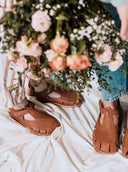
How to choose the best barefoot shoe for your baby's first steps
The First Steps of a baby represent an exciting and decisive stage in their development. During this process, choosing a footwear made of First Steps for baby Proper footwear is essential to promote healthy foot growth, improve balance, and allow little ones to explore their surroundings freely and safely.
In recent years, specialists in pediatric podiatry and motor development have highlighted the importance of respectful footwear and of footwear barefoot for babies, designed to mimic the feeling of walking barefoot while protecting their feet from outdoor or uncontrolled surfaces.
At home and in controlled areas, the best option will always be BAREFOOT WALKING
The footwear from First Steps is specifically designed for babies who are starting to stand, maintain balance, and take their first independent steps. It is considered First Steps when your baby is able to take 10 steps unaided, on their own.
Unlike traditional shoes, respectful footwear aims to honor the natural anatomy of the child's foot, allowing muscles, tendons, and joints to develop without restrictions.
Why is respectful footwear important?
Experts agree that walking barefoot is the best option whenever possible. However, when the baby needs protection from cold, moisture, or outdoor surfaces, the footwear should offer an experience as close as possible to being barefoot.
During the first years of life, babies' feet are extremely flexible and largely made of cartilage. For this reason, any shoe that is too rigid can interfere with their natural development.
The benefits of respectful footwear include:
When should a baby start wearing shoes?
The general recommendation is that the baby stays barefoot whenever it is safe to do so, especially indoors. Shoe use should begin when the little one starts walking outdoors or needs protection from certain surfaces.
How to choose the right size
Choosing the right size is just as important as selecting a respectful model. To find the correct measurement:
It is recommended to check the size frequently, as children's feet grow quickly during the first years of life. To do this, you can remove the insole and see if there is an imprint, or place the insole against the wall and the foot on top.
Discover the entire collection of First Steps MINIS and choose the best respectful footwear for your baby, the best friend in their First Steps.